

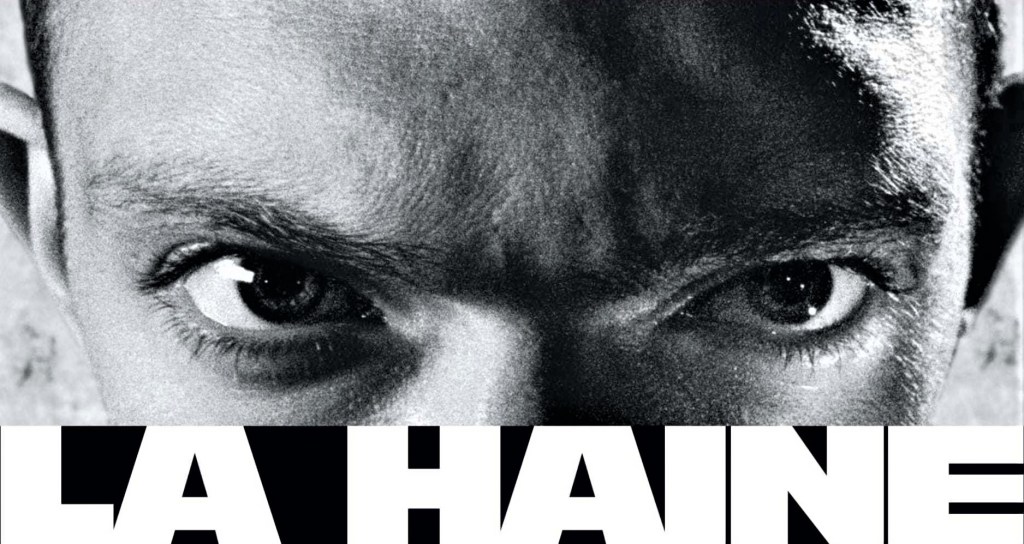

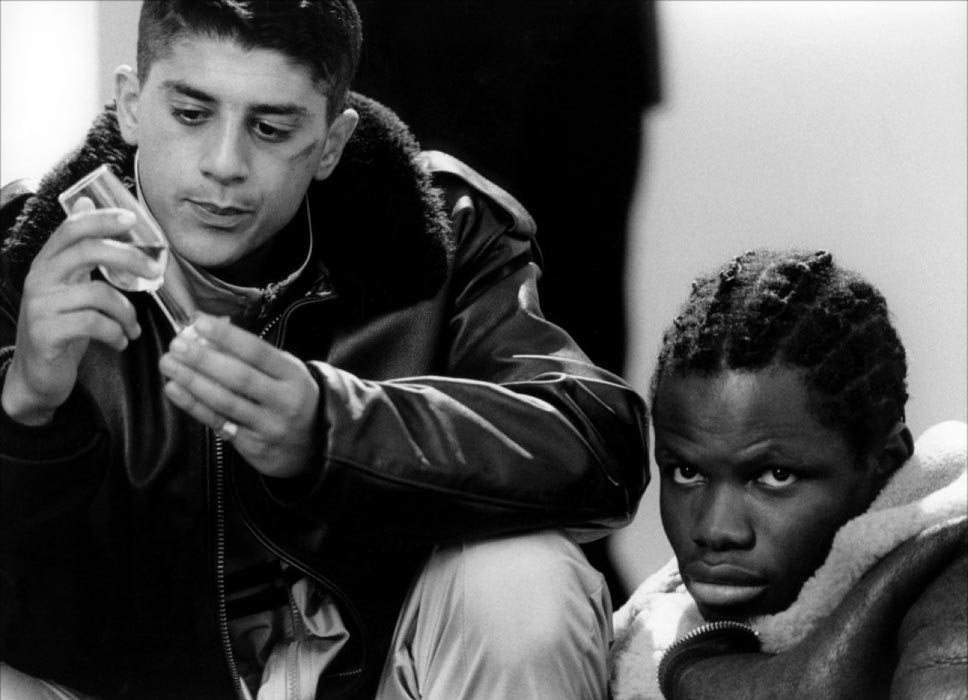
La Haine (“Hate”) is a 1995 French social thriller film written, co-edited, and directed by Mathieu Kassovitz. Starring Vincent Cassel, Hubert Koundé and Saïd Taghmaoui, the film chronicles a day and night in the lives of three friends from a poor immigrant neighbourhood in the suburbs of Paris.
Spoilers ahead!!!
1: Vladimir Propp’s Dramatis Persona in La Haine
The Hero: While I would say that Hubert plays the hero role in a traditional sense, he doesn’t have the same level of dilemma or growth that Vinz does, whom I think is the movie’s obvious protagonist, despite also being the villain archetype (see next). Vinz is always center stage in La Haine, in the middle of the group, and the character we spend the most time with alone. For much of the movie, he is rash and incompetent but at the end he makes the crucial decision of giving away the gun/power, in otherwards he has learned something about himself and grown. I think the ending, although contrived, cements Vinz’ position, after all, what typically happens to the hero at the end of a story?
The Villain: I’d argue that Vinz also acts as the villain archetype within the movie. While the entire gang are prone to ire, Vinz is the one that escalates the situation with extremist tendencies brought on by his ultracrepidarian view of justice, he is the one with the gun after all, despite proving himself a paper tiger and renouncing this in the end.
The Princess: I’d say the object that Vinz and the gang desire in La Haine is justice. Justice for their friend in hospital, justice against police brutality, and justice against societal inequality.
The False Hero: For me Hubert plays this role. The movie explicitly portrays him as ‘the one above it all’ and the voice of reason, yet when it comes down to it, we see that this is a wry verisimilitude; he is his own worst enemy. Whereas Vinz realises he’s not a gung-ho killer and gives up the gun/power in the end, Hubert’s qualities are denigrated, ultimately resulting in the very thing he was against (using the gun/violence) and him not achieving the catharsis that Vinz does. The key scenes where I got this notion were:
- At the Art Gallery where a lecherous Hubert is initially respectful and confident towards the women but immediately devolves when his friends aren’t and escalates it into a scene.
- The scene where the gang corner the skinhead and Hubert tries to coerce Vinz into shooting him, despite his attitude of disarmament all-throughout the movie.
The Dispatcher: Overall, this archetype is fulfilled by the gang’s friend in hospital – their reason/excuse for heightened hostilities. Later, it’s fulfilled by the character who sends them to the other part of Paris to find Snoopy/Asterix.
The Donor: The police officer that helps Saïd out of jail and attempts to dissuade the gang from getting into further trouble. The drunk who impedes the police car.
The Helper: Saïd is a strong contender here. He often plays the role of mediator between Hubert and Vinz, is never shy to crack a joke, and sticks with the gang through-and-through.

2: How the Hero, Villain, and Princess Archetypes Drive the Story Forward
Hero: Vinz’ turmoil of having the newfound power of the gun serves as the overarching tension point of the film and we as the audience are always wondering when his anger will boil over – it gives every scene an open-endedness and piques the viewer’s interest as to what is going to come next.
Villain: Vinz’ furor breaks up what would otherwise be another monotonous day for the gang, spurred on by the Princess.
Princess: The notion of justice and revenge fuels the subtext behind the gang’s journey across Paris and serves as an opaque device the director uses to build tension throughout the movie. If the movie focused solely on this, it would be much darker and less humanizing to the characters of Vinz, Said, and Hubert, and instead we get distractions from it in the form of comedic relief and bored meandering that give greater effect to memorable scenes.
3: Hybrid Genre
A hybrid genre applies to media that integrates the subject matter and themes typically expressed in two or more discrete genres. Other nomenclature for hybrid genre includes mixed genre, multi-genre, fusion genre, and cross-genre. Some examples of hybrid genre media include Let the Right One In (horror, bildungsroman, romance), Gone Girl (crime-mystery, dark-comedy), and Frankenstein (gothic, sci-fi).
4: List of Genres La Haine Straddles (other than drama)
- Crime: Is an integral backdrop in the film, noticeably larceny and drug dealing.
- Bromantic Comedy: There are scenes littered throughout that simply focus on the relationship of the trio, often with them razzing each other in jocular fashion.
- Satire: there are a handful of moments in the film where it pokes fun at its characters through self-awareness, such as the folly of pride from the old man bathroom scene.
- Social Thriller: Towards the end of the movie when we get some semblance of structure (the gang is stranded and need to get home) the movie incorporates a greater sense of anxiety of what’s going to happen next rather than a misch-mash of seemingly discrete events.
- Bildungsroman: Albeit a perverse, darker take on typical coming-of-age stories.
- Urban Fiction: The characters curse, the film’s is dark, and it’s set in a city, go figure.
- Surrealist: I say this more so for the excellent cinematography, which casts a smokey glass vision over the plot at times.
5: An Example of a Genre Trope the Movie Avoids and One It Embraces
The film avoids any forced romantic love interest I see in other similar films. The audience’s empathy is construed through seeing the pallid environment the characters exist in and the loyalty they have for each other.
The film embraces the ‘disenfranchised protagonist(s) incapable of interacting with normal people’ trope that is common in social drama films like Fight Club, and One Flew Over the Cuckoo’s Nest, this is most evident in the Art Gallery scene.
6: Freudian Symbolism/Semiotics
Semiotics is the study of signs or sign-using behaviour, or “the life of signs within society” as defined by Swiss linguist Ferdinand de Saussure.
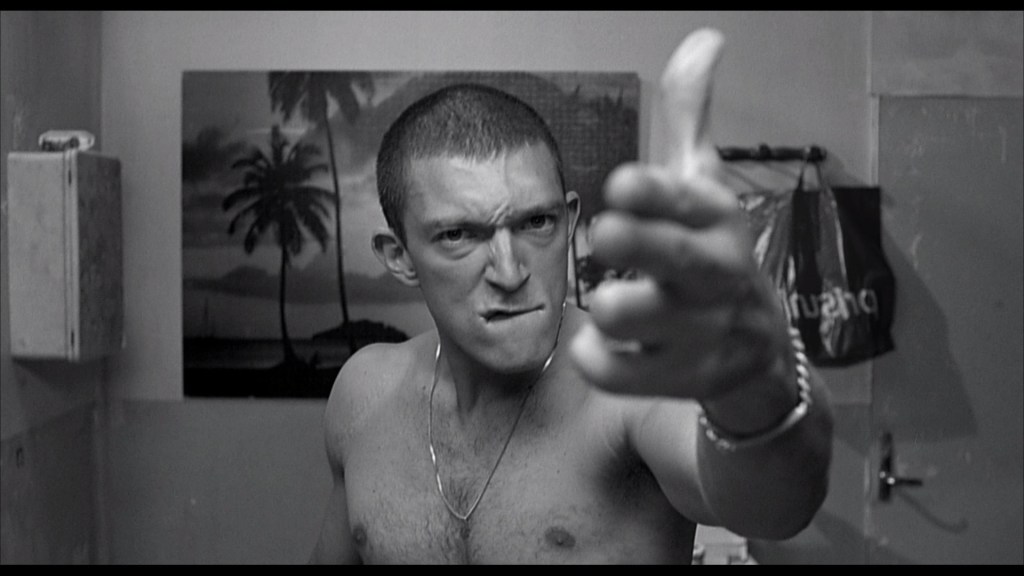
When discussing Freudian Semiotics, his work in dream analysis plays a significant role. From this he suggests that concepts represented by symbols in dreams include the human body, familial figures/roles, birth and death, nakedness, sexual proclivities, and a few others.
According to Freud’s book The Interpretation of Dreams (1900), most symbols are reserved for sex. Male genitalia are represented by anything phallic or penetrating like guns, knives, poles, trees, pencils, etc. Female genitalia are represented by anything capable of being filled or objects that enclose space like caves, bottles, shoes, pockets, etc.
7: The Use of the Symbol of the Cow
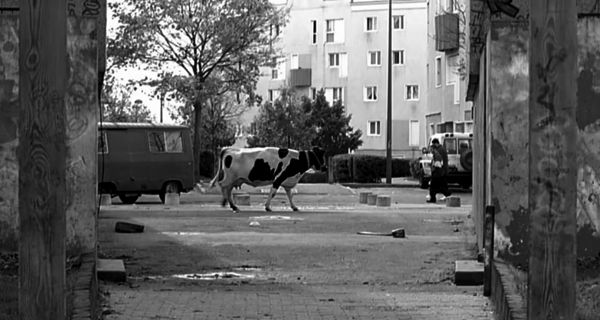
Throughout the movie, characters repeatedly use ‘Vache’ as a pejorative term for the police, in the opening scene we see Said scrawl the term in marker on the back of a police van – in what I believe to be an intentionally placed scene by the director to setup the somewhat esoteric symbolism of the cow used in La Haine.
At first, I thought it to simply be part of the vernacular of disaffected youth the movie portrays; however, an obtuse and seemingly random scene where a literal cow appears, far from any pasture, makes me think there’s more to this symbolism than petty nomenclature.
Vinz is the only person who sees the cow, so I must assume it holds more meaning to his character’s place within the story and to his worldview. He is the most vocal about getting revenge for his hospitalized friend, almost to the level of obsession, but is ultimately unable to carry it out. Maybe the cow represents the inner awkwardness and ugliness he feels about this inner turmoil, as if he feels himself a lummox for being unable fulfil the role of ‘hero’.
8: Stuart Hall’s Representation Theory Applied to the Movie’s Depiction of Youth

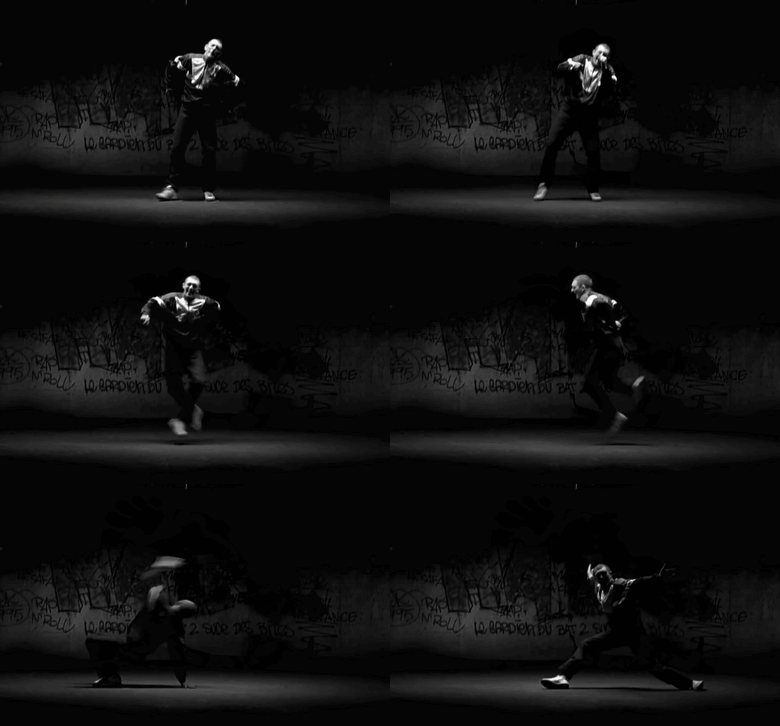
Graffiti (the singular of which is graffito, fun fact!) – The graffiti in the movie seems to commentate on what’s happening within the story of the movie. e.g. We repeatedly see the slogan “The World is Yours.” conveniently at times where the characters are pondering life or experiencing a crisis.
Real-world graffiti, from what I’ve seen, tends to be more incongruous to what I’m currently thinking about. Instead, being a random misch-mash of stylized “gang” names and bubble-words.
The graffiti in the movie is obviously staged by the director as a subtle way to reflect and heighten the circumstances and emotions felt by the characters and to pose the questions to the audience: What is this character thinking about? How does their environment affect them?
9: Feminism
Whenever I am asked what feminism means I always think back to a quote I heard from one Susan B. Anthony, a prominent leader of the Women’s Suffrage Movement in 1800’s America:
“Men, their rights, and nothing more; women, their rights, and nothing less.”
I admire the simplicity of this quote, it hammers home a core concept of feminism that a lot of people (especially in modern times) misconstrue – that it is not about establishing women as superior to men; rather, it recognises the disparity between freedoms afforded to one sex against the other and puts forward an argument for change.
I don’t believe the ultimate goal of feminism is to establish men and women as equals in every conceivable aspect, each has their disparate needs, I believe true feminism is more aligned with removing the animosity between the sexes and pushing forward to create a more harmonious existence for both.
10: The Art Gallery Scene from a Feminism Perspective

In a movie containing a paucity of female characters, the Art Gallery scene in which the gang unsuccessfully attempt to woo some women with their chauvinist charm stands out as a poignant reminder of the difference in maturity between the gang and ‘regular’ people.
The titular scene begins with some offhand cleavage as the woman with glasses and her friend scootch pass Saïd before they exeunt to the right. The entire gang immediately objectifies and gawks at them before Saïd goads Hubert into making an introduction.
It starts casually enough, the women are placid with just Hubert, but as the rest of the gang crowd around they become visibly uncomfortable. From what I can piece together from the subtitles, the inexperienced Saïd aggressively jumps the gun and asks, or rather demands, for their phone numbers. Upon the slightest criticism of this approach, he becomes indignant and curt, and the interaction quickly begins to sour. The woman with the glasses expertly shuts them down and outlines why their approach didn’t work but is subsequently ignored and belittled by both Saïd and Vinz and an argument breaks out before the gang are evicted from the gallery.
From this scene we can gauge that the gang didn’t think very highly about these women (and likely about women in general) in the first place. Saïd’s, and by extension the gang’s, expectant reciprocity and obsequiousness are a strong indication of having a subservient feminine stereotypical viewpoint. This is shattered by the demureness displayed by the women and conflict arises, hammering home the immaturity of the gang.
Whether this scene is a result of groupism or whether the characters actively despise women is hard to say – there aren’t enough interactions provided in the film to make a clear judgement; I’d say within the context it more so highlights how lacking in sophistication and feminine savoir-faire they are when taken out of their familiar, proletariat surroundings.
Bibliography
Kiehn, N. (2023) Propp’s 8 dramatis personae – owlcation, owlcation.com. Available at: https://owlcation.com/humanities/Propps-Dramatis-Personae (Accessed: 12 December 2023).
Cole, S. (2022) What is a hybrid genre?, TCK Publishing. Available at: https://www.tckpublishing.com/hybrid-genre/ (Accessed: 12 December 2023).
Ding, K. (2017) The 20 best genre-hybrid movies of the 21st Century, Taste of Cinema – Movie Reviews and Classic Movie Lists. Available at: https://www.tasteofcinema.com/2017/the-20-best-genre-hybrid-movies-of-the-21st-century/ (Accessed: 12 December 2023).
Semiotics (2023) Encyclopædia Britannica. Available at: https://www.britannica.com/science/semiotics (Accessed: 12 December 2023).
McAndrew, F.T. (2018) The Freudian symbolism in your dreams | psychology Today, Psychology Today. Available at: https://www.psychologytoday.com/us/blog/out-the-ooze/201801/the-freudian-symbolism-in-your-dreams (Accessed: 12 December 2023).
~ G.G. Sept. 2024


Leave a Reply