



The path to becoming a published writer is a long and lonely road littered with endless branching paths and broken dreams. It takes an incredible amount of skill, patience, and above all, perseverance, to establish yourself as a writer and it takes a whole lot more work to become successful.

To be a writer, especially in the fields of fiction and poetry, is a gambler’s game with little career security. You may get lucky churning out ignominious treacle like E. L. James; you may find yourself impecunious and lachrymose for most of your career – despite a bevy of sound work – it’s a vast and complex industry with no single itinerary for success.
Hyperbolic sentiments aside, this essay aims to provide some general knowledge around the jargon and vocational aspects of the journalism and literary publishing world, as well as a primer in copyright law and ways to approach publishers as a first-time writer. Like in most creative fields, there are no guarantees of success, but with an understanding of the proverbial playing field, the adroitness to spot an auspicious opportunity, and an itsy-bitsy sprinkling of razzle-dazzle, we may just make a writer of ourselves yet.
Important Roles Within the Publishing Industry

- A Literary Agent is someone who works on an author’s behalf, either individually or part of a larger agency, presenting work to publishing houses and negotiating publishing contracts. Agents typically reserve a percentage of the proceeds set out in a publishing contract in addition to the costs of advertising, print, and submission fees, etc. It is important to seek out agents that specialize in the genre of your work and we go into more detail on this point in the ‘Pathway to Publishing’ section.
- A Publisher or Publishing House markets and distributes books. They can also provide editing, design, and translation services for books. A publisher also manages any publishing rights associated with the work including movie rights and international distribution rights.
An Editor provides revision and correction on written work. Types of editing include:
- Copy Editing: Is simply correcting any grammar, misspelling, and punctuation errata within the text.
- Line Editing: Focuses on the phrasing of sentences and overall style of language used – often combined with copy editing.
- Developmental Editing: Is geared towards mentoring authors in establishing concept, content, and structure of a novel or manuscript.
- Substantive Editing: Indicates significant changes to the structure, content, or style of a work.
- Proofreader: Performs late-stage editing and final checks for consistency.
Copyright Law
Copyright is used to protect the original works of authors/creators against being exploited or claimed by others without paying any royalties or renumeration. Copyright applies to a variety of works such as books, audiobooks, blogs, and film scripts. It does not protect ideas.
In Ireland, copyright is automatically granted to a work from the moment of creation and there are no registration procedures. The duration of copyright protection varies depending on the format of the work:

Other countries have their own specifications for copyrighting work. Ensure you do your research and are familiar with the conditions needed to attain the appropriate protection.
The format to show that a work is claimed under copyright is:
©Copyright [name of creator/owner] [current year].
This is typically added to the publisher information page in a book or in a website’s footer section. However, this doesn’t legally constitute proof of ownership – you should always retain proof of ownership of your work, e.g. a timestamped copy of the original file or document. Bytescare describes a number of ways you can prove copyright ownership of your work.
With copyright protection the owner of a work has the right to authorize or prohibit others from reproducing the work, adapting it into other formats such as a screenplay, broadcasting it, etc. Breaching copyright protection is known as copyright infringement, and it is the responsibility of the creator to defend their works through the relevant legal procedures.
Vocational Aspects for Writers
In this section we look at a handful of writing careers within the business, journalism, and creative fields. Listings of jobs postings for writers may be found on job sites, or even here on LinkedIn, but it’s often more beneficial to go directly to the website of a news agency or production studio and find their ‘careers’ section to connect with the relevant contacts directly.
Also, one of the most important tools a writer can have is an up-to-date and accessible portfolio. This is a collection of relevant work that you can showcase to prospective employers alongside your CV and exuberant personality. A portfolio can take many forms from a curated collection of work shared via email or the cloud, to your own showcase website.
Here’s a video from The Career Zoo which gives an overview of 5 different writing careers.
Content Writer

A Content Writer role is applicable to a variety of work across multiple industries. It typically requires writing skills and a knowledge of the industry itself, e.g. if working for a sports brand as a content writer you would be expected to know about the sports industry and develop media around it in the particular ethos of that brand. The job of a content writer ranges from writing:
- Web content/blogs
- Marketing and promotional materials – often on social media
- Product and services content
- Technical writing – documentation, user manuals, etc.
- Social media content – this role is often part of a Social Media Manager
An example of a listing for a professional content writer:

Jobs in Journalism

Some common positions for journalists include:
- Reporter – writing material for and covering news stories for web, TV, and radio, typically within a particular area such as sports or politics. This role relies heavily on research skills and investigative journalism.
- Columnist – writes opinion pieces for newspapers. The name derives from the vertical strips of text found in a newspaper. Columnists often cover sensationalist news with the intent on evoking a response from readers.
- Editor – the work of a newspaper editor can range from writing and editing articles and editorials, pitching coverage ideas, and assigning the stories the newspaper publishes. Higher-up editors may also oversee all writers and editors and manage the newspaper’s budget and social media accounts.
Jobs in Creative Writing

The creative job market is volatile as it largely depends on the success of the project (book, film, show, game, etc.) you’re working on, its continuation, your fame, and other projects you can Segway into.
- Author – Writes novels and works with agents and publishers to distribute their work to an audience.
- Writer – A broad term meaning someone who writes and develops work for media such as TV and video games.
- Screenwriter – Involves writing scripts and directions for film and TV.
- Editor – Manages the design and structure of print and digital media. Performs copyediting and proofreading for novels etc.
The Pathway to Publishing
The Traditional Publishing Process
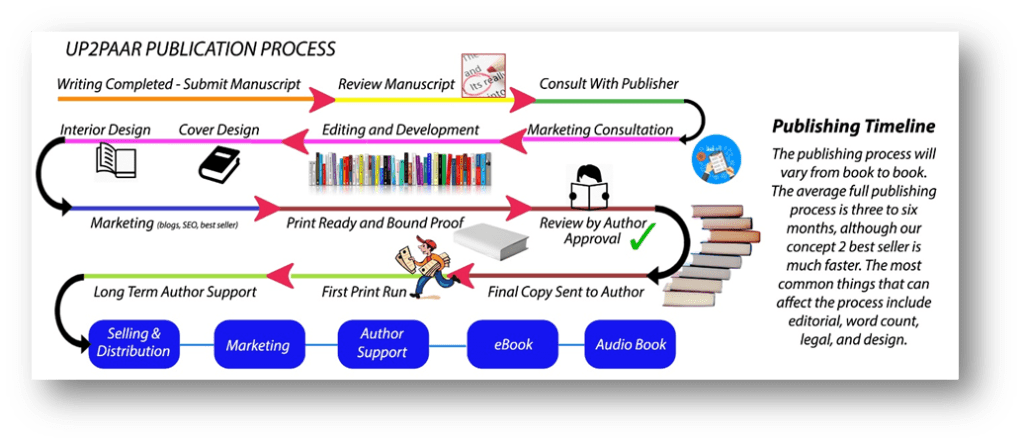
Traditional publishing involves an author working with a publisher, either directly or through a literary agent. Essentially, it’s a symbiotic relationship whereby the author produces the work and the publisher markets and distributes it to the public. This allows a writer to focus on their craft without worrying about advertising, typesetting, and the cover design of their books:
Self-Publishing
Self-publishing through platforms such as Amazon Kindle and Google Books entails the author taking on the role of publisher. In addition to creating the work, you are also responsible for the marketing, promoting, and networking of your work. It can be quite difficult to make a living this way unless you have a sizeable audience, but it can be helpful to showcase your talent and indicates to agents and publishers that you are serious about writing.
Finding a Publisher/Literary Agent
Whether submitting a book directly to a publisher or to a literary agent, it is important to research into the track record and genre-specific material the agent deals with – there wouldn’t be much sense in submitting a bespoke, gothic horror novel to a publisher of children’s picture books. Common requirements for reaching out to publishers/agents include:
- Query Letter: This is essentially a one-page pitch of your book designed to seduce the agent into requesting the full manuscript. It contains details like the book’s title, genre, word count, hook, and a short author bio.
- Book synopsis/proposal: This is a one- or two-page summary of the novel, from beginning to end. *For nonfiction, this is extended to 20-30 pages and covers things like target demographic, comparable titles, and marketing strategy.
- Sample chapters: A handful of sample chapters from your book, starting from the beginning of the manuscript.

Further Resources:
- Glossary of proofreading and editing terms
- 100 common publishing terms
- Different types of jobs at a newspaper
Are you currently searching for a publisher? Are you a published author already? I’d love to hear about your journey so far below 🔮
 Giuseppe Gillespie Writing
Leave a comment